BSP


Blue Sea Tip
Nihongo Support

Vocab at Bottom
The following tip has been provided by Todd Adkisson, an editor for several Blue Sea Wordbooks. Star rating: ☆☆☆☆★
Purpose
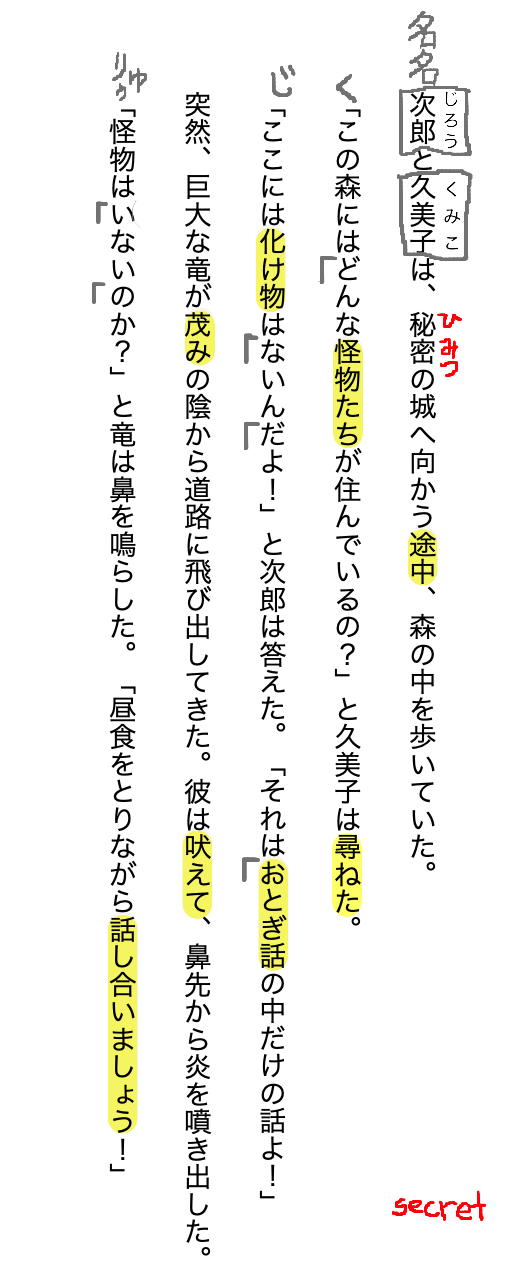
Writing notes on the page can be a big help for the reader.
Don’t remember a reading for a word?
Write your own furigana next to the word.
Can’t remember what a word means?
Write a one or two word definition in the bottom margin of the page.
Even if you are using a Blue Sea Wordbook for checking the readings and meanings of many words in the original Japanese book, there will be some words that the wordbook does not contain and you want to know more about those words.
Preparation
All you need is a pencil or other writing instrument you like to use.
Execution
While reading, identify each word that you have a question about.
It could be that you remember the meaning but you cannot remember the reading (pronunciation).
Or furigana on the page may be showing you the reading, but you do not know what it means.
And then there is the possibility that you need both: the reading and the meaning.
After looking up the word in a dictionary or by some other search method, write the furigana next to the word and/or a short definition (one or two words) in the bottom margin of the page under the line in which the word appears.
It is not such a great idea to write long definitions because it may turn out that there are many words on the page for which you need a note, and in that case the bottom margin would be squeezed for room.
Furthermore, regarding the writing of your own furigana, it can be helpful with names for which the book only gives the furigana at the first instance and then leaves it to you to remember the reading. When the first instance was on page 4 and then again on page 189, it can be a hassle to find the reading.
Writing the furigana at a few places in the book along the way can help you to remember the reading even in places where you have not added furigana.
Evaluation
Finish the book you that you have been reading while marking a few words with furigana and adding a few definitions on pages.
It took some effort and time. It wasn’t easy to add the marks.
Now ask yourself if you know Nihongo a little better than you did before.
Whatever your answer, remind yourself that the best part is yet to come.
After a few months or a year or two, open up the same book again.
At this point, at the second reading of the book, you will be able to tell if those marks and definitions make it easier to read the book.
The marks are already there on the page, so you are not taking time to do it. You are simply collecting the benefit from your own work: you get to read the book in a much more fluid and enjoyable way while understanding everything in it.
See the following related tips:
Blue Sea Tip
A Blue Sea Tip is a suggested practice that may help a person to make progress in the learning of Nihongo (the Japanese language). The intended audience is people who are learning Nihongo as a second language.
Go to Blue Sea Tips.