BSP


Blue Sea Tip
Nihongo Support

Highlight Words
The following tip has been provided by Todd Adkisson, an editor for several Blue Sea Wordbooks. Star rating: ☆☆☆☆★
Purpose
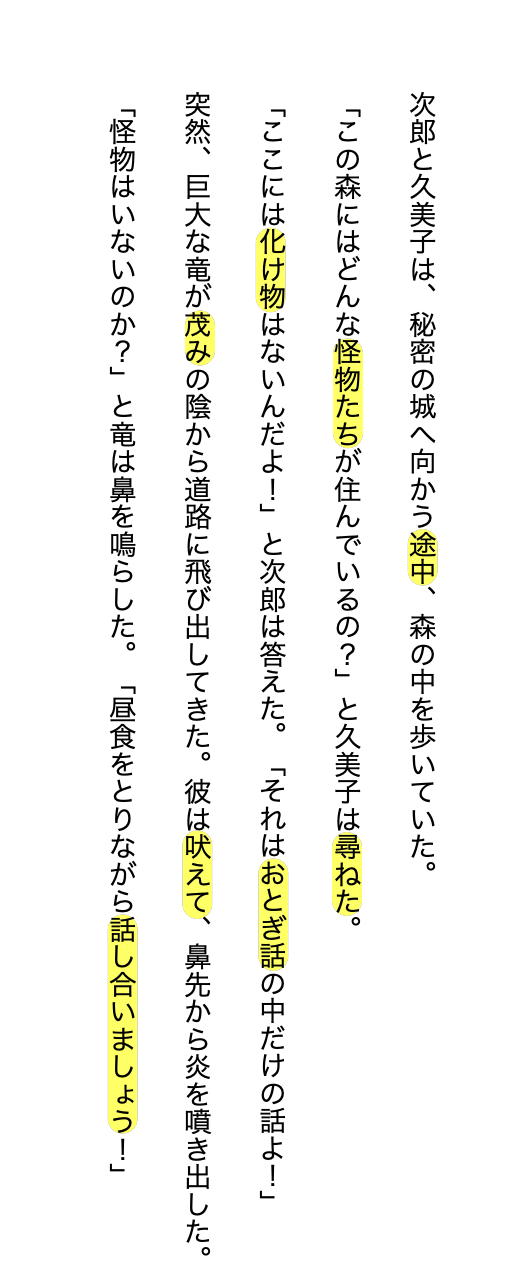
Highlighting words that are unfamiliar or difficult to remember will help the learner clarify which terms are in need of more attention.
This has benefits on the first reading, but it is even more valuable in a subsequent reading of the same book.
If using a Blue Sea Wordbook, marking the words in the original book makes clear to the reader which words will appear in the wordbook and which will not.
During reading of the original book, the user can aim for smoother reading by turning to the wordbook only when necessary and when it is clear that the word in question will appear in the wordbook.
Preparation
Get a highlighter.
Some highlighter models apply a large amount of liquid to the page, and it could bleed through to the other side of the paper. In this case, it helps to use a tissue to dry the surplus liquid before it can bleed.
In place of a highlighter, the user may prefer to use a pencil to draw a line next to the target word. Using a pencil is especially practical when reading a book with thin pages, such as a bunko (pocket-size book).
Execution
Highlight difficult words as you read.
If the user is employing a Blue Sea Wordbook and has highlighted in advance the vocabulary of the original book in correspondence to the entries of the wordbook, the user may want to choose a different color to highlight additional vocabulary that does not appear in the wordbook.
This will allow the user to pay greater attention to the personally identified words.
Evaluation
After reading for several pages, think about whether the highlighted words are becoming more familiar.
If using a Blue Sea Wordbook, confirm that the wordbook has been helpful in quickly learning about the highlighted words.
When reading a book for which the wordbook lists the same vocabulary word again and again on separate pages, consider whether or not the word has become learned to the point where you no longer need to consult the wordbook during a later appearance of the word.
Keep in mind that a subsequent reading of the same book can yield great benefits, and prior highlighting of words during the first reading will mean the step has already been completed for the second reading.
It will be interesting for you to question at a later date whether the highlighted words have become thoroughly learned. As you read and notice the highlights, you will be able to say, “There was a time when I did not know that word, but now I do.”
See the following related tips:
Blue Sea Tip
A Blue Sea Tip is a suggested practice that may help a person to make progress in the learning of Nihongo (the Japanese language). The intended audience is people who are learning Nihongo as a second language.

Go to Blue Sea Tips.