BSP


Blue Sea Tip
Nihongo Support

Name at Top
The following tip has been provided by Todd Adkisson, an editor for several Blue Sea Wordbooks. Star rating: ☆☆☆☆★
Purpose
Many Nihongo books, speaking of novels, give hiragana for the first appearance of a kanji name, and then they do not give furigana again for the rest of the book. This is particularly true of books meant for adult audiences.
The author and publisher are expecting the reader to remember the reading of the name (pronunciation) after seeing it just at that first instance.
This can be quite a problem for an NSL (Nihongo second language) learner who may not be familiar with the name when first encountering it and therefore has a hard time remembering the reading at a later page.
Writing a note at the first appearance of the name will help the reader by making it easier to find that location again later in order to refresh one’s memory about the reading of the name.
By the way, a Blue Sea Wordbook does not list proper names, in the same way that a dictionary does not, except in special cases.
Preparation
All you need is a pencil or other writing instrument you like to use.
Execution
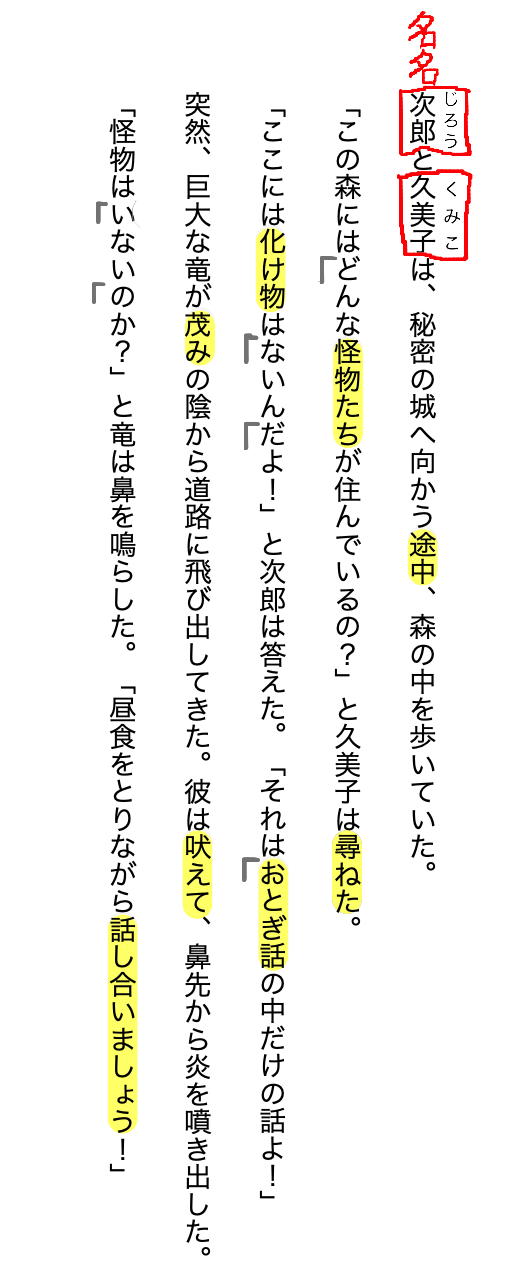
While reading the book, at each first appearance of a name of a character, write the character 名 in the top margin of the book.
Secondarily, you can also place a square box around the name and its furigana to make it easier to locate the name quickly.
Thereafter, when reading later in the book, sometimes many, many pages later, if the name appears again and does not have furigana next to it, you will be able to look back through formerly read pages to find the name and gain the reading from the furigana.
When looking back through the book, it will be very difficult to locate the name if it was not marked in some way, but with the 名 character in the top margin of the page, you will find it fairly easily.
Most books will have several characters, and therefore you may have occurrences of the 名 letter at one page here and another page there, so it will still take some searching to find the right name, but it will still be much easier than trying to scan all the text of the book to try to find a particular name.
Evaluation
After reading a book while having marked the names along the way, ask yourself if you ever went back to find a name for which you could not remember the reading.
The more you read, the more likely this is to happen. In the cases it does happen, you will be glad you marked the names.
See the following related tips:
Blue Sea Tip
A Blue Sea Tip is a suggested practice that may help a person to make progress in the learning of Nihongo (the Japanese language). The intended audience is people who are learning Nihongo as a second language.

Go to Blue Sea Tips.