BSP


Blue Sea Tip
Nihongo Support

Ji Over Quote
The following tip has been provided by Todd Adkisson, an editor for several Blue Sea Wordbooks. Star rating: ☆☆☆☆★
Purpose
Like books in other languages, Nihongo novels often include dialog.
There may be quite a lot of dialog. There may be more dialog, and dialog on top of that, and then some additional dialog.
All of this is great for the NSL (Nihongo second language) learner because he or she will get to see the language as it is spoken between people.
However, a problem arises when quote after quote appear on the page and you cannot quickly identify which character said the words.
As in other languages, attributions often appear (“Jiro said, ‘Konnichi ha’”), but, as also happens in other languages, a series of quotes may appear with no attributions. It is assumed from the context and/or the content that the reader will be able to identify who spoke the words.
But this can be difficult, depending on the characters of the story and the things they are saying.
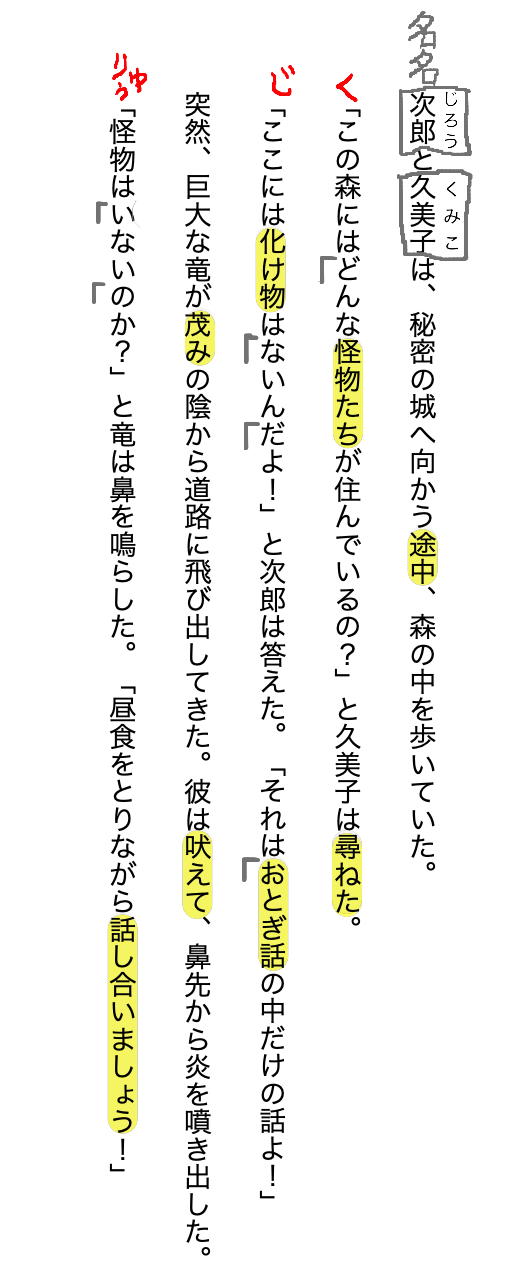
Placing a small hiragana character above the quote to represent the name of the speaker can help a great deal, especially with subsequent readings of the book.
Preparation
All you need is a pencil or other writing instrument you like to use.
Execution
While reading through a passage that has quotes, write a hiragana moji over the quote in the top margin of the page.
Of course the moji you choose should be the first hiragana letter of the reading of the character’s name.
Evaluation
This practice can help even during a first reading of a book, especially if you have to go back and read through a conversation more than once to refresh your memory about who said what.
But the practice is very beneficial during the second reading of the book, which may be several months or years later.
With a moji in place over each quote, you will know exactly which character of the novel is speaking, and this allows you to read faster with a natural flow to the language.
By the way, it may be helpful to recall that scripts for plays and movies always put the name of the character in the margin next to the person who is supposed to speak the line. Nobody says, “Hey, you can tell from the context who is supposed to speak that line.”
See the following related tips:
Blue Sea Tip
A Blue Sea Tip is a suggested practice that may help a person to make progress in the learning of Nihongo (the Japanese language). The intended audience is people who are learning Nihongo as a second language.

Go to Blue Sea Tips.