BSP


Blue Sea Tip
Nihongo Support

Memorize Vocab
The following tip has been provided by Todd Adkisson, an editor for several Blue Sea Wordbooks. Star rating: ☆☆☆☆☆
Purpose
There are a lot of ways to render words in Nihongo.
The writer can use kanji, or hiragana, for each and every letter within a given word.
Mathematically, that exponentially increases the possibilities as the word has more syllables.
Compare that with English, where you can have uppercase or lower case letters.
Applying oddball combinations of uppercase or lower case letters in an English word does not inhibit your ability to read the word.
With Nihongo, it is different.
If you do not understand the various readings that can be represented by a kanji and you do not discern which readings apply in particular words, your job of reading properly becomes much harder.
Learning vocabulary increases your chances that you will either immediately understand the reading of a given word or that you will be able to decipher it based on patterns seen in other words.
Execution
Learn lots of vocabulary words.
Learn lots of kanji.
For the NSL (Nihongo second language) student, this was always an obvious goal, but the learner needs to turn up a notch.
While regular vocabulary words (those that are straightforward and do not have derivatives) are important, there are a lot of words in Nihongo that need attention because the same word can be orthographically represented in several different ways, and the learner needs to recognize that it is the same word no matter which orthographic form appears.
The following gives examples of various types of such words.
A simple type is a word that can have okurigana but can also appear without the okurigana and the reader is expected to read it as though the okurigana were present.
The abbreviation 取引 is to be read the same as 取り引き.
Another type is a word that can be read in two different ways and have a separate meaning for each way it is read.
“目下” and “目下” provide a good example.
The first instance is read “めした” an refers to someone who is of lower status than another given person, and the latter is “もっか” and denotes the here and now.
Only the context of the sentence can tell you which reading and meaning is intended.
Then there are hundreds of compounds that can be presented with kanji or without, and yet the reader is expected to know the correct reading regardless of the rendering used.
The following is an exaggeration and some forms are preferred over others, but you could possibly see: 書き込み、書込み、書きこみ、書込、かき込み、書きこみ、and all would be read “かきもみ” and mean the same thing.
A personal favorite is the type that uses the same orthography but completely changes the reading of the word by the adding of okurigana.
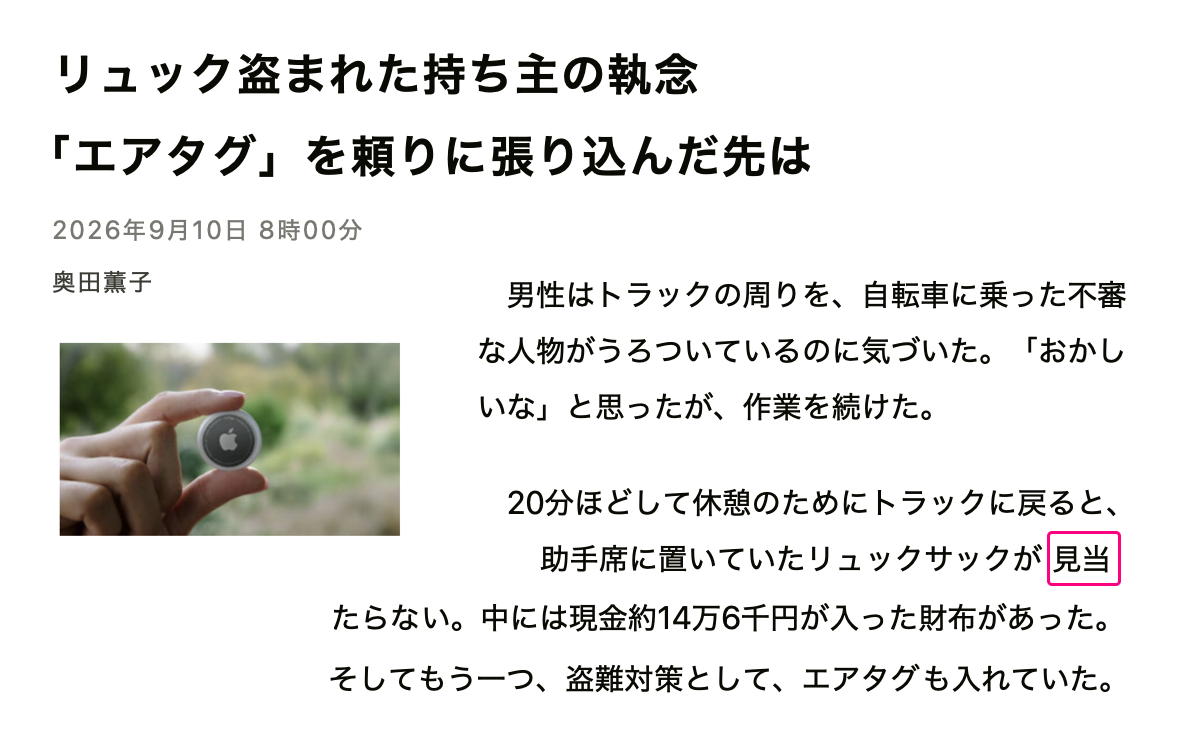
Take the word “見当”.
The first two characters are exactly the same, but the reading is completely different.
Without understanding both words, it would be difficult to quickly identify and read the word correctly in a real world sentence.
See the illustration on this page that comes from a news story published by Asahi.com on September 10, 2026.
If you don’t read the following line before pronouncing the word, you will get the reading wrong. See the word with the red frame.
It is also important to understand that this does not happen with every word in a sentence.
Instances of the types described above appear occasionally, once or twice on a page.
But they do appear, and the point here is that the more vocabulary you learn, and the more you learn to recognize the patterns that are used to create acceptable derivatives of words, the better able you will be to deal with the derivatives and continue reading.
Memorizing vocabulary is an important step so that you can identify a word even if it is a derivative.
Blue Sea Tip
A Blue Sea Tip is a suggested practice that may help a person to make progress in the learning of Nihongo (the Japanese language). The intended audience is people who are learning Nihongo as a second language.

Go to Blue Sea Tips.